Introduction
The IT channel has always measured itself in units shipped, margin per box, and speed to fulfillment. Increasingly, it is also measured in tonnes diverted from landfill and compliance with producer-responsibility law. Sustainability is no longer a slide appended to a distributor’s annual report — it is becoming a condition of doing business, driven by the scale of the waste stream the industry generates and by regulators no longer waiting for the market to self-correct.
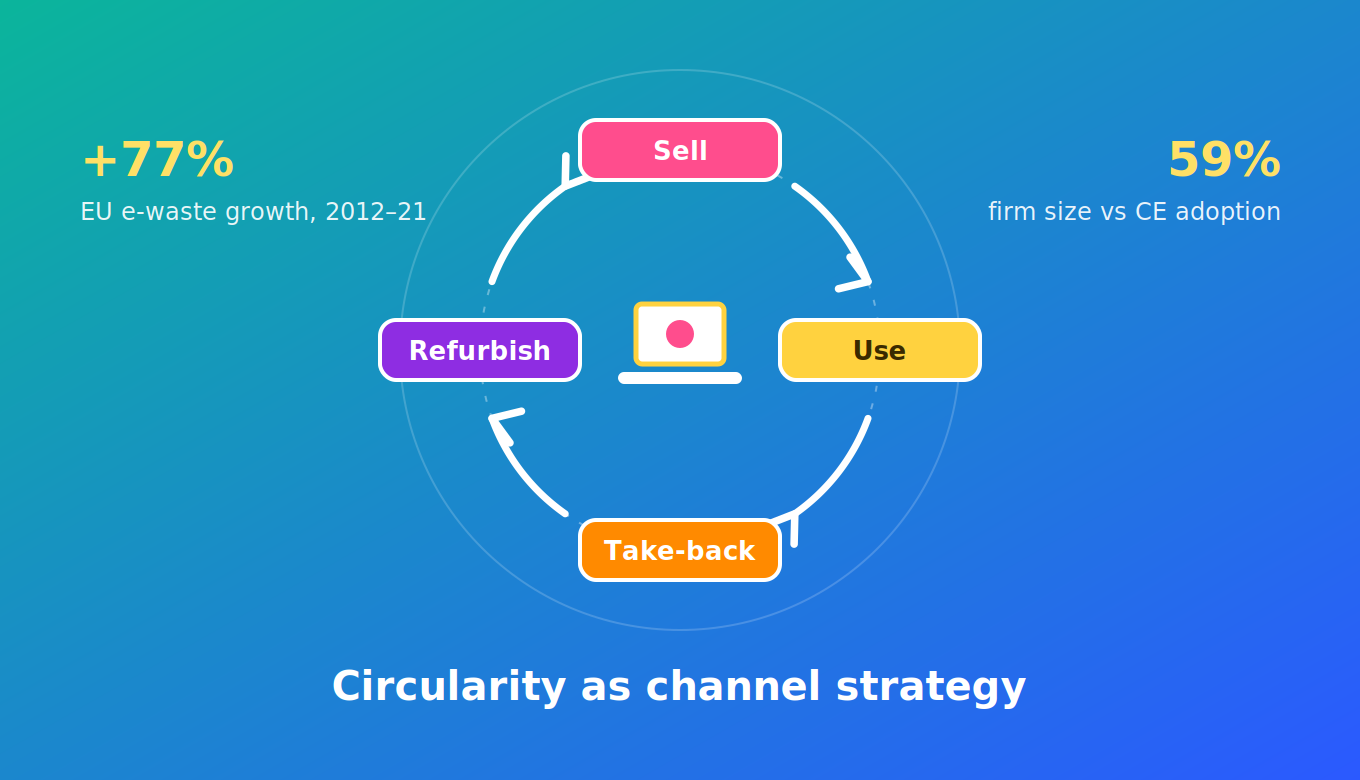
Electric and electronic equipment waste — WEEE — is one of the fastest-growing waste streams in the world, and the volumes are not abstract. In the European Union alone, WEEE generation rose from 7.6 million tonnes in 2012 to 13.5 million tonnes in 2021, a 77.1% increase, even as formal collection struggled to keep pace. Every laptop, server, router, and monitor that moves through a distributor, reseller, or vendor’s channel today will eventually re-enter this stream — and how it gets there, formally or informally, is increasingly the channel’s problem to own. This matters specifically to distributors, resellers, and vendors because they sit at both ends of the product lifecycle: they control what enters the market and, through take-back, trade-in, and refurbishment programs, they are best positioned to control what responsibly exits it. The central argument here is straightforward — circular-economy practices are shifting from a differentiator to a baseline expectation across IT distribution, and channel businesses that treat this as regulatory overhead rather than commercial strategy will find themselves exposed on both fronts.
The Problem: A Widening Gap Between Consumption and Responsible Recovery
The IT channel’s sustainability problem has four interlocking dimensions: scale, informality, weak verification, and uneven capacity to respond — and they compound each other.
The volume problem is structural, not cyclical. Even as recovery infrastructure has improved, only a small percentage of total WEEE generated worldwide is properly collected and recycled, and a considerable share of what is generated still ends up in landfill without treatment. The EU’s own progress illustrates the gap: while recovered WEEE increased from 2.6 to 4.4 million tonnes between 2012 and 2021, that growth trails the underlying waste generation rate, meaning the shortfall between what’s produced and what’s responsibly processed is widening even in one of the world’s most regulated markets.
In fast-growing markets, informal channels routinely outcompete formal ones. India — among the world’s major e-waste-generating countries — has built a progressively stronger regulatory architecture, but consumers and bulk generators continue to rely on informal collection because it is convenient, price-responsive, and capable of immediate collection — advantages that authorized recyclers, bound by compliance overhead, often cannot match. The consequence is not merely inefficiency: informal and hybrid e-waste value chains frequently involve unsafe practices such as open burning, manual de-soldering, acid leaching, and uncontrolled heating, creating environmental and occupational health risks that sit well outside any channel partner’s brand tolerance, even when the exposure is several tiers removed in the value chain.
Regulation without verification produces compliance on paper, not in practice. This is perhaps the sharpest risk for distributors relying on Extended Producer Responsibility (EPR) frameworks to satisfy their sustainability obligations. Research on EPR in developing economies cautions that producer-responsibility systems can generate “paper compliance” where reverse logistics are weak, enforcement capacity is limited, and informal actors are never credibly integrated into the formal system. A distributor that certifies EPR compliance without confidence in the underlying Monitoring, Reporting, and Verification (MRV) infrastructure is exposed to exactly this gap — a compliance certificate that doesn’t reflect what actually happens to the hardware.
Channel structure itself is a barrier to circularity, and smaller partners bear the brunt. Survey data from the electric and electronic equipment industry in Slovenia and Croatia shows a strong, statistically significant relationship between company size and circular-economy implementation — a Pearson correlation coefficient of 0.77 between firm size and CE adoption, with regression analysis showing that firm size alone accounts for 59% of the variance in CE implementation levels. In practice, micro and small enterprises face the most significant barriers to CE adoption — primarily financial resources and funding, followed by a lack of awareness and education, while larger firms possess the capital and compliance infrastructure to move faster. Since IT distribution channels are built on layers of micro, small, and mid-sized resellers beneath large vendors and tier-one distributors, this size effect maps directly onto channel structure: the partners least equipped to absorb sustainability costs also handle the largest share of end-of-life transactions with customers.
Demand growth guarantees the problem will not shrink on its own. India’s electronics consumption reached roughly USD 85.7 billion in 2016–17, with projections anticipating growth toward USD 400 billion by 2023–24 — a trajectory echoed across most emerging markets the channel serves. Every unit of that growth eventually becomes end-of-life hardware, and without a corresponding scale-up in formal recovery capacity, the volume gap between what’s sold and what’s responsibly retired will only widen.
The Solution: Circularity as Channel Strategy, Not Compliance Overhead
The response the evidence points toward is not a single program but a structural shift in how distribution channels think about the hardware lifecycle — treating reuse, refurbishment, and verified recovery as revenue-generating functions rather than end-of-pipe cost centers.
Extend product life before recovery becomes necessary. Product-service systems (PSS) — leasing, sharing, and pay-per-result models — give companies a direct incentive to design and manage products for durability and upgradeability, since the provider retains ownership throughout the product’s life. For distributors and resellers, this reframes hardware-as-a-service not just as a financing option for customers but as a circularity mechanism: equipment that stays on the books longer, gets maintained rather than replaced, and returns to a single, traceable custodian at end of life is inherently easier to refurbish, resell, or recycle responsibly than equipment sold outright and scattered across thousands of end users.
Build reverse logistics that can compete with informal collection on convenience, not just price. The evidence from India is instructive precisely because it shows what happens when formal channels fail this test: informal collection wins because it is more convenient and immediate, not because it is cheaper. A commercially viable circular strategy for distribution therefore needs take-back and trade-in programs integrated into the normal purchasing transaction — collection at the point of sale or renewal, not as a separate errand the customer has to initiate.
Make traceability a sellable feature, not just a compliance artifact. Blockchain technology can make the origin of a product, the parties involved in its handling, and its movement through the supply chain visible, traceable, and verifiable to everyone in that chain, directly addressing the MRV weaknesses that produce “paper compliance.” For a distributor, provable chain-of-custody on retired hardware — proof it went to an authorized recycler rather than an unverified intermediary — is a genuine differentiator to enterprise customers who carry their own ESG reporting obligations and are increasingly asking suppliers to substantiate, not just assert, their disposal claims.
Recognize that regulation is tightening the definition of “compliant,” not just adding paperwork. The EU’s Ecodesign for Sustainable Products Regulation (ESPR), in force since 2024, broadens ecodesign requirements from energy-related products to virtually all physical products, covering durability, circularity, and overall environmental footprint. Combined with the existing WEEE Directive, which holds producers financially responsible for collection, treatment, and disposal, the direction of travel is toward channel partners being expected to demonstrate circularity outcomes, not merely participate in a scheme that claims to deliver them.
How the Solution Gets Implemented: From Policy Framework to Channel Practice
Translating this into working channel practice means building specific infrastructure and partnerships at each stage of the product’s movement through distribution.
At the policy layer: use EPR obligations as the anchor, but verify what sits beneath them. The WEEE Directive’s requirement that producers finance collection, treatment, and disposal of e-waste gives distributors a concrete compliance target to build reverse-logistics programs around. But given the documented risk of paper compliance in less mature regulatory environments, channel partners operating across multiple geographies should treat EPR registration as a floor, not a guarantee, and specifically ask recovery partners how material flows are monitored and verified after collection — the same MRV gap that constrains India’s transition is a risk anywhere formal and informal recovery channels coexist.
In infrastructure: cluster-based recovery platforms can do more than standalone recyclers. India’s proposed Eco-Park model positions dedicated facilities as service platforms linking EPR incentives, MRV systems, informal-worker integration, safeguards, and staged technology deployment, rather than treating recycling infrastructure as a standalone facility disconnected from the informal collectors who already do much of the on-the-ground gathering. This is directly relevant to distribution channels operating in emerging markets: partnering with or investing in these integrated platforms, which formalize and safeguard rather than bypass existing informal collection networks, is likely to yield more reliable recovery volumes than trying to build a purely formal parallel system from scratch.
In channel design: match the sustainability ask to partner capacity. Since CE implementation correlates strongly with company size, and micro and small firms cite financial resources and lack of awareness as their primary barriers, while medium-sized firms cite regulatory complexity and stakeholder resistance, a one-size-fits-all sustainability mandate imposed on an entire reseller network is likely to fail at the smaller end of it. Practical implementation looks like tiering: large distributors and vendors absorbing the compliance and infrastructure cost of take-back and refurbishment programs, then offering smaller resellers a simple, low-friction way to plug into that infrastructure — shipping labels, pre-negotiated recovery partners, and pooled reporting — rather than expecting every micro-reseller to build independent capability.
In technology: apply automation where volume and inconsistency make manual sorting impractical. AI-based image and video analysis can classify and detect WEEE types, and forecasting models combining historical data with machine learning can estimate future e-waste generation and reusable-component volumes, while IoT-enabled systems can improve collection routing and lower transportation costs, and give customers a formal, convenient channel to track their own e-waste footprint — directly addressing the convenience gap that pushes volume toward informal collectors. For distributors managing take-back at scale, this kind of tooling is what makes formal recovery programs cost-competitive with the informal alternative, rather than merely regulation-compliant.
In market development: fund the secondary market, don’t just fund collection. Governments can support development of a secondary raw-materials market by building recycling and remanufacturing facilities, reducing reliance on virgin resources and import-dependent supply chains. Distributors have a direct commercial stake in this: a functioning secondary market for recovered components and refurbished units is what turns end-of-life hardware from a cost center into a revenue stream, supporting certified refurbished product lines that extend margin on hardware already sold once.
Conclusion
The throughline across both the mature-market and emerging-market evidence is the same: regulation is necessary but not sufficient. The EU’s WEEE Directive and ESPR, and India’s shift toward target-based EPR, all demonstrate that policy frameworks can raise the floor on formal compliance — but neither the EU’s recovery-rate growth nor India’s 2022 rules have closed the underlying gap between consumption and responsible recovery on their own. What closes that gap is channel infrastructure: reverse logistics that outcompete informal collection on convenience, traceability that makes compliance verifiable rather than assumed, and partnership models that extend circular capability down to the smaller resellers who handle the bulk of end-of-life transactions but lack the resources to build it alone.
For distributors, the takeaway is to treat take-back, refurbishment, and verified recovery as core commercial infrastructure, not a compliance line item bolted onto existing operations. For vendors, it means designing products and channel programs — leasing, trade-in, PSS models — that keep hardware traceable and recoverable by design, not as an afterthought once it leaves the warehouse. And for resellers, particularly smaller ones, it means recognizing that the sustainability expectations now arriving from enterprise customers and regulators alike are not going to shrink back down to optional — the channel partners who build circularity into their commercial model now will be the ones equipped to compete when it becomes the baseline for doing business with every major customer and regulator in the market.