Intro
Cooling used to be an afterthought in data centre design — a supporting system that quietly kept operations within safe limits while decisions were driven by compute, storage, and networking. That balance is now being disrupted, as AI chips run so hot that cooling is becoming one of the biggest challenges in modern data centres. As organizations deploy more powerful CPUs, GPUs, and TPUs, heat generation is rising at a pace many facilities were never built to handle, pushing cooling from an operational detail into a strategic constraint on how fast AI infrastructure can grow.
Problem Faced
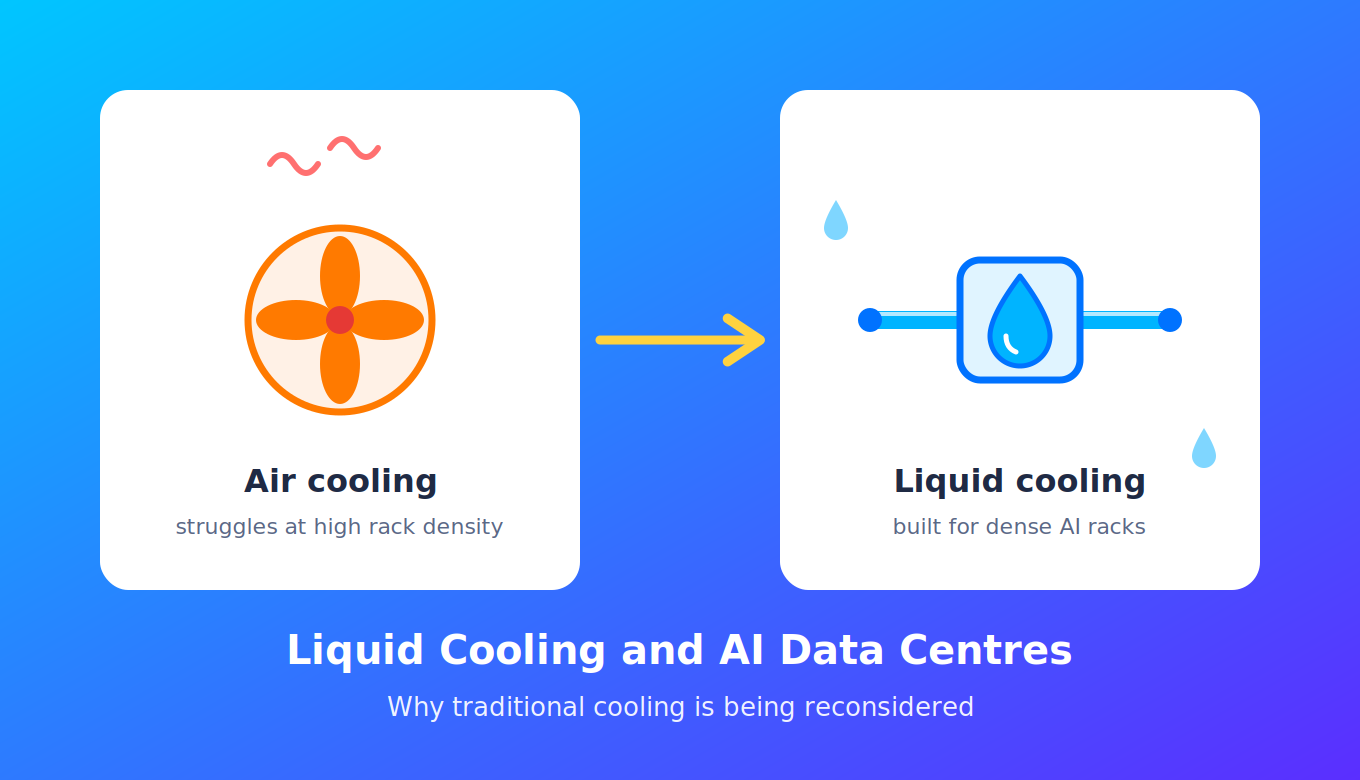
The scale of the thermal shift is stark. Racks that once operated at 5–10kW are being replaced by AI systems drawing 60kW or more, with some high-end deployments exceeding 100kW per rack, while individual GPUs now draw 700W–1,200W each. Conventional air cooling is typically effective only up to around 20–30kW per rack, and separate analysis confirms this ceiling, noting that air cooling can be inadequate for rack densities of 20kW or more, and even where it technically works, it is seldom the most efficient option. Past this threshold, the problem becomes structural rather than tunable — there is a hard physical limit to how efficiently air can move heat, and simply increasing airflow isn’t enough to keep pace.
The resource strain goes beyond electricity into water, and here the picture gets more complicated depending on where facilities sit. A typical 100MW hyperscale facility using water-based evaporative cooling can consume around 800,000 litres of water per day, and in the US, large data centres use up to 5 million gallons of water daily across direct and indirect sources. This matters most where facilities cluster near stressed resources: two-thirds of new US data centres built since 2022 are in areas already facing water stress, and in India specifically, 57% of districts are at high to very high risk from extreme heat, with many key data centre hubs located in exactly these districts — a compounding risk, since extreme heat both raises cooling loads and increases exposure to climate-driven outages.
Cooling is also an outsized cost driver: it can account for more than half of a data centre’s operational expenses, and on average represents about 40% of a facility’s total power costs. At the grid level, the implications extend well past any single facility: in India, data centre electricity demand is projected to increase nearly fivefold by 2030, from roughly 13 TWh in 2024 to approximately 57 TWh, concentrated around urban hubs already facing renewable-energy integration constraints. Left unmanaged, this localized, always-on demand can strain grid stability, slow power-sector decarbonisation, and push utilities toward fossil-fuel generation to guarantee reliability.
Solution
Liquid cooling addresses the core physical limitation of air directly: liquids simply move heat far more efficiently. Liquids can transfer up to 3,000 times the cooling efficiency of air and can be directed straight to the heat source, which is why more data centres are turning to liquid cooling, particularly direct-to-chip approaches, as densities climb past what air can manage.
Direct-to-chip cooling works by placing cold plates directly onto the highest-heat components — CPUs and GPUs — with coolant flowing through the plates to absorb heat at the source before carrying it away through a coolant distribution unit (CDU) that manages temperature, pressure, and flow, while sensors monitor for leaks. Because it targets only the components generating the most heat, the rest of the system can continue relying on familiar air-cooling approaches, letting organizations improve cooling performance where it matters most without redesigning their entire environment.
Not all liquid cooling looks the same, and the distinctions matter for adoption decisions. Immersion cooling takes the most radical approach, fully submerging servers in dielectric fluid that doesn’t conduct electricity — highly effective for extremely dense environments, but requiring a substantial rethink of how the data centre operates. By comparison, direct-to-chip cooling lets servers largely keep their familiar design, so day-to-day maintenance doesn’t change dramatically, making it a more practical entry point for many organizations. A third option, rear-door heat exchangers, captures remaining heat as air leaves the rack, pushing densities higher without overloading the system, and is often paired with direct-to-chip setups rather than used alone.
How the Solution Was Implemented
In practice, liquid cooling adoption is proceeding as a hybrid transition rather than a wholesale replacement of air. Within direct-to-chip deployments, most organizations start with single-phase liquid cooling, where the coolant stays in liquid form throughout — simple, easy to manage, and a natural fit with existing operational models. From there, some facilities are shifting to warm-water cooling, which takes advantage of water’s heat-absorption efficiency to avoid running at the low temperatures traditional air-cooled environments require, reducing the need for energy-intensive chilling.
The efficiency gains from this shift are measurable. Liquid cooling generally consumes about 10% less energy than air cooling, translating into roughly 10% lower carbon emissions, with immersion cooling capable of lowering energy expenditure by 20% or more depending on deployment scale. Direct-to-chip systems compound these savings further: by applying cooling directly to the heat source, they reduce dependency on cooling fans and allow operators to raise ambient facility temperatures, saving additional power.
The trade-offs, however, are real. Liquid cooling typically requires significant upfront capital investment, and retrofitting existing data centres calls for substantial plumbing work and staff retraining, with many IT teams wary of leak risk given the potential for serious equipment damage and downtime. These factors shape deployment decisions: climate is a major variable, since colder-region data centres can rely on free outside-air cooling, while facilities in warmer or water-stressed areas are more likely to transition to liquid cooling, and organizations are advised to weigh whether AI workloads are actually on their roadmap before committing to a retrofit.
Regional water stress is also reshaping which liquid-cooling variant makes sense. Closed-loop liquid cooling in servers typically uses very little water, but data centres that still rely on water-based heat-rejection systems like cooling towers can carry high overall water consumption — a distinction that matters directly in markets like India, where liquid cooling is expected to become the dominant technology for AI-focused facilities given high ambient temperatures and the extreme heat density of modern AI workloads, even as policymakers push for water-use reporting and efficiency standards to manage the resulting local strain.
Conclusion
Cooling has moved from a background operational concern to a defining factor in how AI data centres are designed, scaled, and governed. Decisions that once sat solely with facilities teams are now firmly on the agenda for CIOs, CTOs, and infrastructure leaders, because thermal design now directly shapes cost, sustainability targets, and competitive growth capacity.
There is no universal answer. Air cooling will continue to support many workloads, immersion cooling will remain suited to specialised, high-density use cases, and direct-to-chip sits between the two as a practical way to manage rising thermal demands without disrupting established operations. What’s clear is the choice can no longer be deferred: as AI pushes rack densities and water demands to new extremes, cooling needs to be considered alongside compute, storage, and networking from the outset, not layered on once thermal limits are already reached.