Introduction
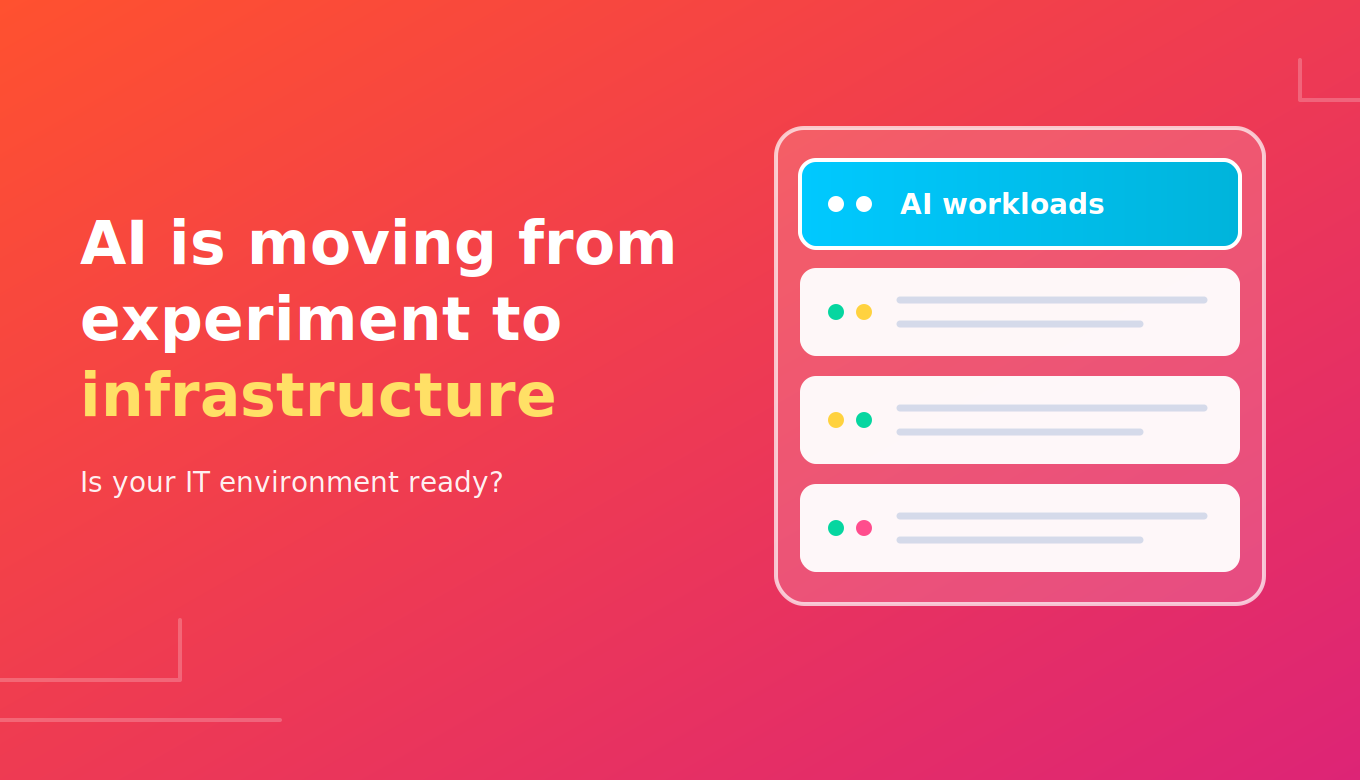
Every enterprise can run an AI pilot. A company can choose a model, connect an API, build a proof of concept, and demonstrate an impressive result within weeks. What’s changed is what comes next. AI adoption has moved past the experimentation phase, and the real challenge begins when a solution has to work across enterprise data, legacy applications, security controls, cloud environments, business workflows, and thousands of users. That shift — from proof of concept to production dependency — is why AI is best understood today not as a tool decision but as an infrastructure decision.
The uncomfortable truth is that AI doesn’t fail because models are weak; it fails because infrastructure can’t move data fast enough, scale predictably, or run reliably across locations. This reframes the central question facing IT leaders: not “which AI should we deploy,” but whether the technology foundation underneath it — data, compute, storage, networking, governance — can actually support sustained AI workloads at enterprise scale.
Problem Faced
The gap between pilot and production shows up in three distinct places: the data layer, the infrastructure layer, and the operating model that governs both.
Data readiness is the most common blind spot. Many enterprises still operate with data spread across ERP systems, CRM platforms, databases, documents, cloud environments, and departmental applications, and technical access to that data doesn’t guarantee it’s accurate, current, or usable. This fragmentation compounds at the infrastructure level: AI pipelines move far more data, more often — logs, images, video, sensor streams — and when that data has to traverse slow WAN links or bounce between silos, latency grows and costs follow.
Traditional infrastructure breaks under AI-specific load patterns. AI workloads behave nothing like the applications most enterprise infrastructure was designed for. Storage that performs fine for general virtualization can struggle with the burst churn of AI training and batch scoring, producing unpredictable job times and missed SLAs. AI also adds new components — pipelines, model registries, monitoring, and security controls — and when each becomes a separate product to deploy and patch, operational risk increases and change slows, a pattern of tool sprawl that scales poorly across distributed sites.
Security and governance can’t be retrofitted. As AI systems process more sensitive information through APIs, agents, and retrieval pipelines, organizations need clear controls around identity and access, data protection, API security, and model and application security, designed into the architecture from the start rather than bolted on later. This matters because AI introduces genuinely new ways for enterprise information to move, interact, and be processed, which existing security models weren’t built to anticipate. The scale of this challenge is organizational as much as technical: Gartner’s 2026 guidance specifically highlights uneven readiness across software engineering, enterprise architecture, infrastructure and operations, data and analytics, and security as a bottleneck to enterprise AI scale.
Autonomy without governance is its own risk. As AI moves from advisory tooling toward taking direct action on infrastructure, capability alone isn’t the goal. As Itential’s Chief Architect puts it, AI is moving at a blistering pace — but “smart” doesn’t mean “safe.” An enterprise that lets AI reason through operational decisions without a governed execution layer underneath it is trading one kind of fragility for another.
Solution
Closing this gap requires treating AI readiness as infrastructure work across three coordinated layers: data, compute/storage/networking, and governed execution.
On data, the fix starts with visibility before ambition: organizations should evaluate where critical business data resides, how it moves between systems, whether data quality is monitored, and who can access sensitive information before scaling any AI initiative on top of it.
On infrastructure, AI-ready infrastructure means running AI workloads end-to-end — ingest, storage, compute, deployment/inference, and monitoring — with consistent performance and security-by-design, without multiplying tools and admin overhead. Critically, this doesn’t require GPUs everywhere: CPUs are often sufficient for preprocessing, classic ML, and many inference workloads, while GPUs matter most for heavy vision workloads or strict latency requirements. The goal is standardization, not maximalism.
On governance, the emerging model separates AI reasoning from the systems it acts on. Automation executes, agentic AI reasons — that’s the critical distinction, and enterprises that keep those two functions architecturally separate can let AI capabilities evolve without destabilizing the operational systems underneath.
How the Solution Was Implemented
Two concrete models illustrate what this looks like in practice, at different layers of the stack.
At the platform layer, Scale Computing’s approach standardizes the infrastructure blueprint itself. Its architecture separates AI storage tiers with snapshots and replication for protection, a compute layer combining CPUs with optional GPUs, and a platform layer for policy automation, delivered through products including SC//HyperCore for hyperconverged virtualization and SC//Fleet Manager for centralized edge orchestration. This lets multi-site organizations with lean IT teams reduce site-by-site variation through standardized infrastructure and central control, rather than building bespoke stacks at every edge location.
At the governance layer, Itential’s approach implements the reasoning/execution separation as a five-phase maturity model, moving organizations from supervised experimentation to full autonomy. It begins with AI in read-only mode, where teams use tools like ChatGPT or domain-specific chatbots to observe and advise without taking action, building organizational trust in low-risk scenarios before any execution authority is granted. It then progresses to AI agents connected through the Model Context Protocol, where agents can prepare configuration changes but a human must still press execute, and eventually to closed-loop autonomous operations where agents detect, diagnose, and resolve issues with minimal intervention, while humans shift toward policy definition and exception handling. Throughout every phase, every proposed action passes through schema validation, role-based access controls, and policy enforcement in a deterministic execution layer that AI reasoning can extend but never bypass — the architectural discipline that makes autonomy safe to expand incrementally rather than all at once.
Conclusion
Across the data layer, the infrastructure layer, and the governance layer, the same lesson repeats: AI capability is not the bottleneck — infrastructure readiness is. Enterprises that treat AI as a bolt-on model choice will keep hitting the wall between pilot and production, while those that invest in comprehensive infrastructure instrumentation, deterministic execution with embedded governance, and progressively expanded AI reasoning build a foundation that scales with confidence.
The strategic priority for IT leaders now isn’t choosing the next AI tool — it’s building the technology foundation that turns AI into measurable business value. Before evaluating another model or platform, the more useful question is the one infrastructure teams should already be asking: is your environment ready for what you want AI to become?