Introduction
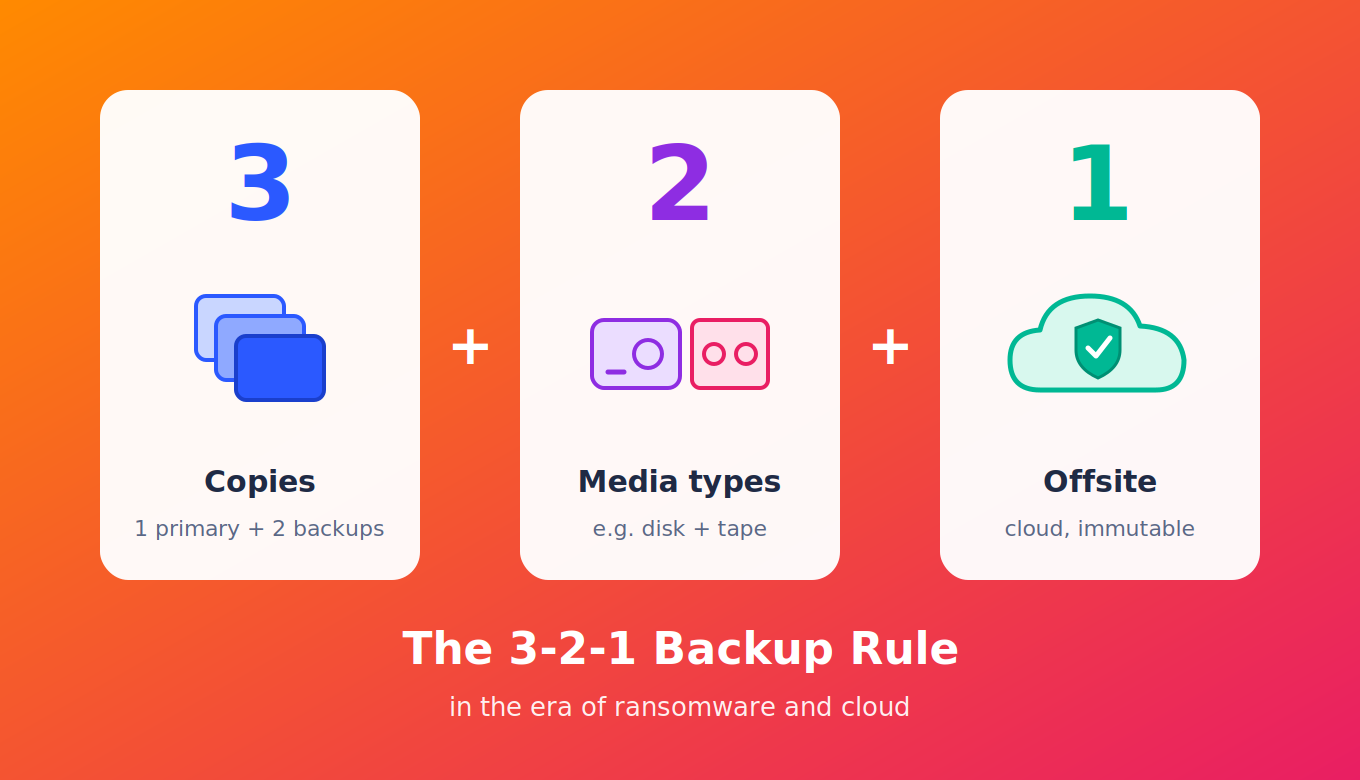
For nearly two decades, the 3-2-1 backup rule has stood as one of the most widely adopted data protection principles in IT: keep three copies of your data, store them on two different types of media, and keep at least one copy off-site. It’s a simple idea, and that simplicity is exactly why it has endured through waves of new technology. But the threat landscape the rule was built for — hardware failure, fire, theft, the occasional accidental deletion — looks very different from the one organizations face today, where ransomware specifically hunts for backups and cloud infrastructure has redefined what “off-site” even means.
The rule isn’t obsolete. It remains a foundational, vendor-agnostic guideline that doesn’t require specific hardware and can be tailored to nearly any environment. But on its own, in a world of ransomware that actively targets backup systems, a 3-2-1 strategy without immutability or recovery verification creates blind spots that attackers and failure events can exploit. This article makes the case that the 3-2-1 rule is still the right starting point for enterprise data protection — but that organizations now need to treat it as a foundation to build on, not a finished strategy, by adding immutability, verified recoverability, and cloud-aware implementation to close the gaps ransomware has learned to exploit.
The Problem: Why Classic Backup Assumptions No Longer Hold
The core logic of the 3-2-1 rule — redundancy, media diversity, and geographic separation — was designed to answer a specific set of failure scenarios. Hardware still fails, ransomware is still prevalent, human error remains a reality, and site outages continue to occur, so that logic hasn’t disappeared. What’s changed is the sophistication and specific targeting of the attacks layered on top of those older risks.
Ransomware now targets the backup itself, not just production data. The clearest sign of this shift is how vendors describe the threat: ransomware increasingly targets backups directly, and if an organization’s only protection is a copy connected to the network, that copy can be compromised right along with production systems. This inverts a core assumption behind the classic rule. The 3-2-1 model was built to survive a fire or a disk failure destroying one location; it was not built to survive an attacker who deliberately seeks out and encrypts every reachable copy, including the “second” and “third” ones, before the ransom demand ever appears.
Modern threats weren’t part of the rule’s original design. The 3-2-1 rule was developed at a time when tape libraries and physical media dominated backup workflows, well before ransomware, immutable storage, or public cloud were part of the picture. Even sources defending the rule’s continued relevance acknowledge its limits: it does not specifically address modern threats like AI-assisted ransomware or the full complexity of cloud-native environments, leaving a gap between what the rule guarantees and what organizations actually need in the event of a coordinated attack.
A single off-site copy is a fragile last line of defense. Even under the classic model, the risk of concentrating trust in one remaining copy is real: if a cyberattack penetrates the cloud server hosting an organization’s off-site backup, access to that data can be lost indefinitely — and if that happens, even a textbook 3-2-1 setup won’t be enough to save the data. This is the scenario that has pushed vendors to extend the rule rather than replace it.
Complexity itself has become a source of risk. As backup environments span on-premises systems, multiple cloud tenancies, and SaaS platforms, teams can struggle to maintain visibility into where data resides, whether the most recent backup is current, and whether it can actually be recovered successfully — a gap that widens the risk of undetected protection failures. Common operational failure points include fragmented storage, inconsistent policy application, storage sprawl, siloed tools, lack of backup testing, cost management issues, and general operational complexity. None of these are exotic attack techniques; they’re ordinary administrative gaps that, left unaddressed, quietly turn a “compliant” 3-2-1 setup into a false sense of security.
Untested backups are a liability organizations often don’t discover until it’s too late. Without regular testing, organizations may not discover recovery issues until they actually need to recover — at which point it’s no longer a planning exercise but an active crisis. A backup that has never been restored is, functionally, an unverified claim rather than a safety net.
The Solution: Extending 3-2-1 for Immutability and Verified Recovery
The response the industry has converged on isn’t to discard the 3-2-1 rule but to extend it, most commonly into what’s known as the 3-2-1-1-0 model, with a further variant — the 4-3-2 rule — for organizations with stricter regulatory or uptime demands.
Start with what the original rule still gets right. The base model remains straightforward: three total copies of the data, stored on two different types of media, with at least one copy kept off-site — for example, production data on a primary server, a backup on local volume, and a third copy in cloud storage at a different geographic location. Each layer addresses a distinct failure mode: multiple copies guard against total data loss, diverse media types reduce the risk of media-specific failure, and off-site storage protects against localized events like fire, flood, or targeted attacks.
Add an immutable or air-gapped copy as the “+1.” This is the piece purpose-built for ransomware resistance. An immutable or air-gapped copy is essential because it remains unreachable or unchangeable even if the rest of the network is compromised, keeping recovery possible in a worst-case scenario. In practice this can mean an offline tape copy in the spirit of the original 3-2-1 design, or immutable cloud storage where the data cannot be modified or changed once written, often implemented through native cloud APIs such as Amazon S3 Object Lock or Immutable Storage for Azure Blob, which place backups in a Write Once, Read Many (WORM) state.
Add verified recovery as the “0.” The final digit addresses a different kind of risk: trust in the backup itself. The “0” represents zero recovery errors, achieved through regular testing and validation rather than assuming a backup will work simply because it completed. This is echoed independently: zero errors can be pursued through daily monitoring of backup media, correcting errors as they’re found, and performing regular restore tests, while purpose-built tooling can automate recovery verification to confirm backups are complete, bootable, and actually ready to restore — closing the gap between a backup that merely finished and one that will genuinely work in a crisis.
For organizations with stricter compliance or uptime needs, the 4-3-2 model goes further still. This variant expands every element of the base rule: four total copies, stored across three locations — typically on-premises, with a managed service provider, and with a cloud storage provider — so that two of the three locations are off-site, granting higher protection against both disasters and targeted attacks. Organizations with highly distributed operations or strict uptime requirements may find this additional redundancy and storage diversity better suited to environments where downtime or data loss carries significant financial or regulatory consequences, particularly under frameworks like HIPAA, GDPR, or SOX, which may dictate specific requirements for how backup data is stored and protected.
How the Solution Gets Implemented
Turning an extended 3-2-1 strategy into working practice requires attention to both the technology choices and the operational discipline around them.
Choose media and locations deliberately, not by default. Cloud storage provides scalable, off-site protection, but comes with its own cost, bandwidth, and recovery-speed tradeoffs, and spreading redundancy across multiple providers can further improve resilience. Legacy media still has a role in some environments, but maintaining aging tape libraries is expensive and inefficient compared to more scalable object storage options for long-term archiving. For SMBs weighing the classic choice between external hard drives and cloud storage, a hybrid approach combining both is generally the most practical path, balancing the portability of local media with the geographic separation and accessibility of the cloud.
Build centralized visibility across hybrid and multicloud environments. Because fragmented tooling is itself a risk factor, implementation should start with establishing a unified view of data assets across on-premises, cloud, and SaaS platforms to reduce blind spots, followed by proactively identifying where data resides and eliminating silos that lead to inconsistent protection or missed backups — a step that matters most in exactly the sprawling, multicloud architectures where visibility naturally erodes over time.
Standardize policy and automate what can be automated. Consistency reduces the odds that a gap goes unnoticed: applying consistent backup frequency, retention, and security policies across workloads and environments, then incorporating automation to schedule backups, enforce policy, and validate recovery points, reduces both manual workload and human error. For smaller organizations, this can be as concrete as a cadence: performing a full backup of operational data at least once a week, supplemented with daily incremental or differential backups, and retaining full system backups for at least two months to ensure a clean recovery point is available even against malware that sat undetected for a period of time.
Apply immutability and access controls consistently, not selectively. Implementation should apply encryption and access controls consistently across every environment to protect backup data from unauthorized access or tampering, rather than treating immutability as a feature reserved for one storage tier while other copies remain exposed. Organizations can also define immutability periods aligned with their existing data retention policies, so ransomware protection and compliance requirements are handled by the same mechanism rather than two separate, potentially conflicting, systems.
Test recovery on a schedule, not only after an incident. This is arguably the step most often skipped in practice, and the one that matters most. Continuous testing of recovery processes confirms that backups are genuinely usable and meet defined recovery objectives, and automated recovery-verification tooling exists specifically to close this gap by confirming backups are complete, bootable, and ready to restore before an organization ever needs to rely on them under pressure.
Plan for portability across vendors and locations. In scenarios involving supply chain disruption or infrastructure changes, the ability to restore backups from one location to another, and to work across multiple vendors, increases the likelihood of successful recovery — a reminder that resilience depends not just on how many copies exist, but on how easily they can be moved and restored when circumstances change unexpectedly.
Conclusion
The 3-2-1 backup rule hasn’t failed; it’s simply being asked to do a job it wasn’t originally designed for. The underlying logic — redundancy, media diversity, geographic separation — remains sound, and the rule continues to serve as a reliable baseline that organizations can build on. What ransomware and cloud adoption have changed is the cost of stopping there. An attacker that specifically hunts for and encrypts every reachable backup copy renders a purely network-connected 3-2-1 setup far less protective than it once was, and a backup that has never been tested is a plan, not a guarantee.
The extended models — 3-2-1-1-0 and, for more regulated or distributed organizations, 4-3-2 — close exactly the gaps that matter most today: an immutable or air-gapped copy that ransomware cannot reach or alter, and verified recovery that confirms a backup will actually work when it’s needed. For organizations still relying on a basic 3-2-1 model, updating the strategy doesn’t require a full infrastructure rebuild — it means refining existing processes to add immutability, automation, and regular restore testing. In an environment where backup systems are now a primary target rather than a background safety net, that refinement isn’t optional. It’s what determines whether “backed up” actually means “recoverable” when it counts.